 Armand Halbert
Software Engineer
Contact:
armand.halbert@gmail.com
Armand Halbert
Software Engineer
Contact:
armand.halbert@gmail.com
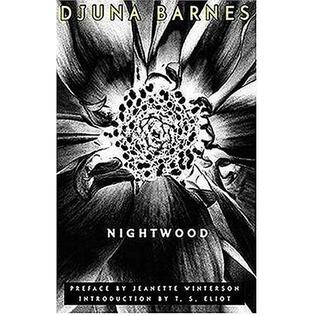
Nightwood
Nightwood. By Djuna Barnes. 180 pages.
To say that Nightwood will appeal primarily to readers of poetry does not mean that it is not a novel, but that it is so good a novel that only sensibilities trained on poetry can wholly appreciate it.
No less a luminary than T.S. Eliot provided the introduction to Djuna Barnes’s 1936 novel. He wasn’t kidding when he said it was more poetry than prose. Nightwood is among the densest books I’ve ever read. Barnes discards niceties like plot and clarity in favor of a dreamlike experience that haunts me to this day. The book can be maddeningly frustrating at times, such as when the action of the plot is relegated to a footnote of a long digression. Pages pass where you track every word and still feel you have grasped nothing. When Ms. Barnes writes, “We look to the East for a wisdom that we shall not use—and to the sleeper for the secret that we shall not find,” she captures in a single breath what makes Nightwood so singular and strange. I understand the words, and they stick with me, but what do they mean?
This is a book that rewards a second reading. The first time, I decided to let Nightwood wash over me, concentrating on the rhythm and sound of the novel rather than the specifics of the plot. The second time, I paused and lingered over the most impactful sentences, taking in the mood and strangeness of Ms. Barnes’s vision.
Nightwood is less a novel than a prose poem about obsession, decay, and the night itself – the hours when our ordinary identity dissolves and our animal natures take over. Almost all the novel is set when ordinary people are asleep, but it is only at night that our characters can become their true selves. Each of them is driven by extreme desires, and each of them is undone by these desires.
The first four chapters introduce the characters and their backstories, their psychology, and their desires. Each of them meets Robin Vote and forms a relationship with her. Robin abandons each of them in turn, and the last four chapters deal with the aftermath.
Dramatis Personae
Robin Vote
The perfume that her body exhaled was of the quality of that earth-flesh, fungi, which smells of captured dampness and yet is so dry, overcast with the odour of oil of amber, which is an inner malady of the sea, making her seem as if she had invaded a sleep incautious and entire. Her flesh was the texture of plant life, and beneath it one sensed a frame, broad, porous and sleep-worn, as if sleep were a decay fishing her beneath the visible surface.
Robin is the center of Nightwood. She forms romantic relationships with three of the main characters, and their obsession with her proves their undoing. A young American woman drifting across Europe, Robin is known for her excess: excessive drinking, numerous lovers, and overwrought emotional outbursts. And yet she remains an enigma throughout the novel. She is given little dialogue and understood only through the eyes of those she leaves behind.
Robin is defined by contradictions: described as “clumsy, yet graceful”, her husband finds her presence “painful, and yet a happiness.” She is restless, developing a habit of disappearing for weeks at a time, wandering the streets of interwar Europe at night. She is a lost soul, forever searching for something she never finds. Robin is someone ill at ease with herself, lacking a secure identity. “A tall girl with a body of a boy”, Robin is often depicted in men’s clothing, hinting that perhaps the root of her issues involves her gender identity. Once she acquiesces to having a child with her husband, Felix, she truly flies off the rails, abandoning her child for a series of lesbian relationships that she also finds empty and unfulfilling. In the final scene of the novel, Robin has descended to acting like a dog, getting on all fours and barking.
Felix Volkbein
He was usually seen walking or driving alone, dressed as if expecting to participate in some great event, though there was no function in the world for which he could be said to be properly garbed; wishing to be correct at any moment, he was tailored in part for the evening and in part for the day.
Felix is an orphan from birth, the son of a self-invented Jewish “Baron” who fabricated a noble lineage before dying alongside Felix’s mother. Felix inherits both the fake title and the obsession with aristocracy that created it. He is a man desperate to belong to a European tradition that will never accept him, surrounding himself with the trappings of old-world culture – titles, antiques, and deference to anyone with a claim to nobility. He marries Robin and pressures her to have a child in the hope that she will give him a male heir to continue his fraudulent dynasty. But Robin is incapable of playing the role Felix has written for her; she abandons both husband and child.
Felix is left with a sickly boy who will never be the vessel for his ambitions. Young Guido is a sickly, emotional boy whose hopes lie in the priesthood. Felix accepts his son’s religious fervor and moves to Vienna so that if his line must end with Guido, it ends in his native Austria. He ends the novel an alcoholic, getting drunk in cafes while Guido watches.
The Doctor
In the old days I was possibly a girl in Marseilles thumping the dock with a sailor, and perhaps it’s that memory that haunts me. The wise men say that the remembrance of things past is all that we have for a future, and am I to blame if I’ve turned up this time as I shouldn’t have been, when it was a high soprano I wanted, and deep corn curls to my bum, with a womb as big as the king’s kettle, and a bosom as high as the bowsprit of a fishing schooner? And what do I get but a face on me like an old child’s bottom-is that a happiness, do you think?
Born Matthew O’Connor, the Doctor is not, strictly speaking, a licensed practitioner of medicine. If Robin is the center of the plot of Nightwood, the Doctor is the novel’s soul. Given to lengthy monologues on every subject from religion to gender to the nature of night itself, he is simultaneously prophet, fool, and confessor. The other characters come to him to pour out their hearts; he responds with streams of consciousness that are as illuminating as they are baffling. He is as fractured as those he counsels; his pain is that there is nobody to listen to his troubles.
When Nora visits him in the small hours, she finds him in bed wearing a woman’s nightgown and wig, surrounded by cosmetics and feminine trinkets. Embarrassed (he was expecting someone else), he confesses his desire to be a woman to Nora. Nora, however, is too consumed with her desire to reunite with Robin to notice how the Doctor is. He ends the novel weeping in a bar, undone by the weight of everyone else’s suffering that he has carried.
Nora Flood
The world and its history were to Nora like a ship in a bottle; she herself was outside and unidentified, endlessly embroiled in a preoccupation without a problem.
Then she met Robin.
Nora is described as “having the strangest salon in America…for Catholics, Protestants, Brahmins, dabblers in black magic and medicine.” Self-assured and confident, she is a publicist for circuses in Europe. She meets Robin, and they become inseparable. Their life together in Paris is intense and claustrophobic – Robin disappears each night, and Nora lies awake tormented by what Robin is doing and with whom. When Robin finally abandons her for Jenny Petherbridge, Nora is destroyed. Unlike Felix, who redirects his loss toward his son, Nora cannot let go. She seeks out the Doctor repeatedly, less for his counsel than for the relief of speaking Robin’s name to someone who will listen. She ends the novel searching for Robin in increasingly desperate ways. Nora’s tragedy is that she loves Robin with a completeness that demands reciprocity – and Robin is constitutionally incapable of giving it.
Jenny Pentherbridge
To men she sent books by the dozen; the general feeling was that she was a well-read woman, though she had read perhaps ten books in her life.
Derisively referred to as “The Squatter”, Jenny’s defining personality trait is having no personality of her own. Married four times and widowed four times, she lives off the income of her late husbands. Unable to feel or create, she survives by absorbing the emotions and experiences of others. Jenny repeats overheard stories as her own, mimicking the passions she cannot generate. When she encounters Robin, she does what she always does: she takes her. She steals Robin from Nora not out of love but out of an insatiable hunger to possess what others desire. Yet even Jenny cannot hold Robin. Jenny throws a fit when Robin starts giving attention to yet another woman. Jenny is presented as a kind of emotional vampire, hollow at the core, and her relationship with Robin is the most joyless in the novel. She is perhaps the darkest mirror Barnes holds up to obsession, desire with nothing behind it at all.
Identity
What had formed Felix from the date of his birth to his coming to thirty was unknown to the world, for the step of the wandering Jew is in every son. No matter where and when you meet him you feel that he has come from some place—no matter from what place he has come—some country that he has devoured rather than resided in, some secret land that he has been nourished on but cannot inherit, for the Jew seems to be everywhere from nowhere.
The novel’s entire cast is composed of people who do not belong and invent a false persona to fit in. Felix has no claim to the aristocracy he craves. O’Connor practices medicine in the shadows and cannot inhabit the gender that fits him. Jenny can only be herself by taking from others. Ms. Barnes published the novel in the 1930s, and it reflects the atmosphere of interwar expatriate Europe, a world of people who had fallen out of the conventional social order. The night of the title is the space they all occupy: the margins, the hours when the respectable world is asleep.
The queer themes get the lion’s share of today’s literary analysis, but Jewish identity runs through the novel in a way that deserves more attention than usually received. Felix’s half-Jewish heritage is a source of both pride and shame for him. His father invented a fake noble lineage partly to escape the stigma of being Jewish in Vienna, but Felix has internalized both the need to belong and the knowledge that he never will. Nightwood vividly illustrates why Zionism was such a force among European Jews in the early 20th century. When assimilation demands the erasure of who you are, and acceptance is never fully granted regardless, emigration to a homeland of your own becomes a coherent answer. Felix’s tragedy is that he cannot accept this. He keeps chasing membership to something he will never belong to.
Relationships
“You know what man really desires?” inquired the doctor, grinning into the immobile face of the Baron. “One of two things: to find someone who is so stupid that he can lie to her, or to love someone so much that she can lie to him.”
Every relationship in Nightwood is structured around an unbridgeable asymmetry. Felix wants a dynasty; Robin wants nothing he can give. Nora wants a complete and permanent union; Robin cannot stay still long enough to be anyone’s. Jenny wants to possess; even she cannot hold Robin. This asymmetry is not a product of cruelty or malice on Robin’s part. Barnes presents Robin as a force of nature, something that comes in and wrecks lives impersonally.
The Doctor is the one character who escapes Robin’s orbit, yet he suffers the same structural loneliness from the other side: everyone unburdens themselves to him, and he has no one to unburden himself to. Barnes seems to be saying that this is the nature of all deep attachment; one person always loves more, and that person is always destroyed.
At the same time, I found the relationships with Robin unconvincing. Why does she marry Felix to begin with? What does Nora see in Robin, who is given so little interiority? The relationships forming get almost no narrative space. Most of the novel is dedicated to the characters’ backstories and destruction, not the actual action of the plot. Barnes may have intended Robin’s blankness as a kind of negative space onto which others project their desires, but the effect is that the novel’s emotional stakes feel asserted rather than earned.
The Verdict
Nightwood is not an easy book, and I don’t think it’s meant to be. It demands patience, a tolerance for beautiful obscurity, and a willingness to let the novel’s images accumulate rather than waiting for plot. On those terms it largely succeeds. The Doctor alone is worth the price of admission – a character of genuine originality, comic and tragic in equal measure. The portrait of Nora’s grief is quietly devastating, all the more so for how little Barnes sentimentalizes it.
The novel’s weaknesses are real. Robin is meant to be unknowable, but Barnes is perhaps too successful at keeping her shrouded in mystery. She never quite coheres into a person, and the relationships built around her feel like they’re orbiting an absence rather than a character. The ending, for all its strangeness, is more striking as an image than as a conclusion. And the density of the prose can tip from lush into impenetrable.
But I think about this book more than I expected to. Its vision of exile, of people who cannot fit into the world as it is arranged endures. Barnes had no interest in reassurance, and the novel doesn’t offer any. What it offers instead is a compassion for her characters, understanding them without accepting their decisions.