 Armand Halbert
Software Engineer
Contact:
armand.halbert@gmail.com
Armand Halbert
Software Engineer
Contact:
armand.halbert@gmail.com
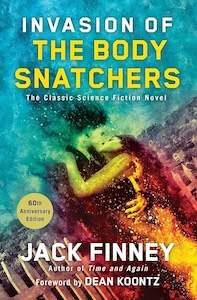
Invasion of the Body Snatchers
Invasion of the Body Snatchers. By Jack Finney. 228 pages.
Jack Finney’s 1955 novel is one of those works that has seeped into popular consciousness without many people watching or reading the source material. The plot is a familiar one: aliens invade earth not with a loud show of technological terror, but quietly and slowly, replacing people one at a time. Author Jack Finney denied writing anything other than a science-fiction thriller, but it’s really a nightmare about 1950s America itself. After reading, the writing may not make an impression, but what lingers is the creeping sense that America was already doing to its citizens what the pod people do more efficiently.
The plot is simple. Dr. Miles Bennell has a small medical practice in Mill Valley, California. Local patients come to him, convinced that their loved ones are no longer their loved ones. They are imposters, identical in every detail, but wrong somehow. After investigating, Miles and a group of Mill Valley residents find that aliens, known as “pod people” have invaded the town and replace existing townspeople with near-perfect duplicates. The only thing missing is what makes them human - emotion, ambition, desire, love. They are people with the people removed.
The pod people live only a few years, consuming all of the life on a planet before launching themselves into space to consume another. Upon discovering the conspiracy, Miles and his friends attempt to sound the alarm, only to find the authorities either don’t believe them or have already been converted. Taking matters into their own hands, they attempt to destroy the farm producing the pods, but fail. Fortunately, the pods decide Earth’s resistance is not worth it and launch themselves into space, looking for an easier planet to consume.
Nobody Believes You
We hate facing new facts or evidence, because we might have to revise our conceptions of what’s possible, and that’s always uncomfortable.
The novel’s central horror is not the pod people themselves but the experience of knowing something is wrong and being unable to convince anyone. The psychiatrist Dr. Kaufman diagnoses the early reports of impostors as “epidemic hysteria”, a mass delusion spreading through a community. He cites a real case of mass hysteria, the Matoon Maniac, when residents of Matoon, IL became convinced someone was gassing sleeping women with a paralytic agent. The truth was there was never a gasser to begin with, instead a mass delusion had taken over the town. Dr. Kaufman is applying a framework of reason to an unreasonable situation. By the time Miles determines that Kaufman is wrong, Kaufman himself has been replaced. The person insisting there is no conspiracy is now part of it.
This is the nightmare within the nightmare. The institutions we trust to distinguish the real from the imagined are themselves vulnerable to replacement, and once they go, our epistemological ground collapses entirely. Who validates the validator? Miles cannot prove the pod people exist to someone who is not one because the evidence is the behavior of people who look and sound completely normal.
Finney wrote at the height of McCarthyism, and the resonance is hard to miss. The novel has been read as an anti-communist allegory, where the pod people are Soviet conformists, the heroes as American individualism under siege. It has also been interpreted as a critique of McCarthyism itself, in which anyone could be accused of being something they were not, and denials were taken as further evidence of guilt. I find the latter interpretation a stretch, because the invasion is real rather than imagined: it’s not paranoia if the conspiracy is real. The anti-communist reading holds up better: the pod people offer exactly what the Soviet project promised: security, equality, freedom from want, an end to competition and conflict, while delivering a nightmarish collective with no room for the individual self.
Technology and Dehumanization
But now we have dial phones, marvelously efficient, saving you a full second or more every time you call, inhumanly perfect, and utterly brainless; and none of them will ever remember where the doctor is at night, when a child is sick and needs him. Sometimes I think we’re refining all humanity out of our lives.
A side theme of the novel is Miles’s discomfort with the modern world. The novel is set in 1976 (though I suspect my edition was edited to fit the 1978 film), a world where the telephone operator has been phased out in favor of automatic telephone switching machines. Dr. Miles Bennell states that he still makes house calls, something that is out of place in modern medicine.
During the 1950s, the cost of labor skyrocketed, and companies increasingly searched for automated solutions to common business tasks. The telephone operator – who knew the doctor’s night schedule and could route an emergency call accordingly – was replaced by the dial phone, which could not. The savings were real; what was lost was harder to quantify.
This is Finney’s deeper argument, more subtle than the pod allegory. Automation does not merely replace labor: it replaces the relationships that we build when we work together. What remains is more efficient but less alive. The pod people are this process taken to its endpoint: perfectly functional humans with the human part automated away. The dial phone is not worse at connecting calls: it is better. The loss is something that we don’t even notice until it’s too late. Finney suggests that this is the real danger: refinement happening without anyone deciding it should, through a thousand small improvements that are individually defensible but collectively devastating.
By the pod people’s logic, they are not replacing humans, but improving them. They eliminate everything inefficient: desire, fear, ambition. A pod person does not suffer. They do not lie awake at night. They have no particular wants that could be disappointed. They are, in a narrow technical sense, optimized.
Finney gives the pod people a chance to make the argument sincerely. When Miles confronts Dr. Kaufman as a pod person, he is genuinely puzzled by Miles’s resistance. What exactly is Miles fighting to preserve? The anxiety? The loneliness? The pods offer a kind of peace, and to them, it is irrational to fight for the right to suffer.
The novel’s answer is that subtracting emotion is precisely the problem. When you subtract emotion, you are not just subtracting suffering, you are subtracting life itself. Miles and Becky fight back against the pod people because of love for each other, something that makes them do irrational things to protect each other. The pods cannot replicate this because they have no use for it, and find it so intolerable that they leave Earth to find easier places to conquer. Finney is not exactly criticizing technology, but rather a vision of technology that delivers comfort by amputating the parts of life that make comfort meaningful.
This attitude spoke to a particular anxiety of postwar America: the fear that prosperity and ease were not the end of the story but a new kind of danger. William H. Whyte published The Organization Man the same year Finney’s novel appeared in print, worrying that corporate life was producing people who had traded individual identity for institutional belonging. The pod people are Whyte’s thesis taken to its conclusion. The 1950s gave Americans television, suburbs, appliances, but mass production also led to conformity and dehumanization: the same model of house on every street, the same product on every shelf. Abundance and sameness arrived together, and Finney was not the only one wondering whether the former was the price of the latter.
The pod people are not malicious. This is what makes them so unsettling. They do not scheme or hate or compete. They simply are, identically, together. No one pod person is different from any other in any way that matters. They share resources, make no demands on each other, and pursue no individual ends. They are the perfect collective.
Finney’s achievement is to make this collectivity feel like death rather than liberation. The pod people have faces Miles recognizes as his neighbors, and they speak to him with those voices, but the person behind the face is gone. Not suppressed or disciplined or repressed, as it might be in an authoritarian society, but genuinely absent. There is nothing left to suppress.
At the same time, Mill Valley before the pods arrive is not a portrait of vibrant individualism. It is a small American town, quiet and neighborly and largely indistinguishable from every other small American town. The pods do not descend on a population of eccentrics and artists and visionaries. They descend on people who were already, in the ordinary social sense, quite similar to their neighbors. The horror is partly that the difference between pod Mill Valley and pre-pod Mill Valley is not as large as we would like it to be. The pods merely make explicit what suburban conformity had been accomplishing more gradually.
The End?
Look, you fools, you’re in danger! Can’t you see?! They’re after you! They’re after all of us! Our wives, our children, everyone! THEY’RE HERE, ALREADY! YOU’RE NEXT!
The novel ends hopefully: the pods, finding Earth’s resistance more trouble than it is worth, launch themselves into space to find easier prey. Miles and Becky survive, and Mill Valley is slowly repopulated, albeit with its earlier residents mysteriously dying early of an unknown illness. It is an ending that fits the 1950s, an era of confidence that Americans can meet any threat.
The film versions of Invasion of the Body Snatchers, in contrast, end much bleaker than the novel: there, the pod people win.
The 1956 adaptation, directed by Don Siegel, originally ended with Miles screaming on the highway before studio pressure added a framing device that restored some hope. The 1978 version, directed by Philip Kaufman and set in San Francisco, dispenses with the frame entirely. There are no survivors. The final image – Donald Sutherland turning to point and emit the inhuman shriek of a pod person – became one of the most disturbing endings in American horror.
The divergence maps neatly onto their respective cultural moments. Finney wrote when American confidence was near its peak. By 1978, after Vietnam and Watergate, the idea that American institutions could be trusted had curdled. The pod people winning felt more honest about how the world worked.
Which ending is truer to the novel’s themes is an open question. Finney’s hopeful resolution sits uneasily with his own argument: if conformity was already doing what the pods do, then defeating the pods does not solve the problem. The 1978 ending takes the subtext seriously. If the pods are a metaphor for what American life was already becoming, then resistance was always futile.
The Verdict
Invasion of the Body Snatchers has survived seven decades because Finney had the instincts of a great thriller writer and the themes of something more serious. The plot moves fast, the dread accumulates efficiently, and the ending – Miles and Becky running through darkened fields while Mill Valley sleeps – remains one of the most effective sequences in American science fiction.
The novel’s weaknesses are mostly those of its genre and moment. The romance between Miles and Becky is sketched lightly enough that their love, which the novel stakes everything on, is more asserted than felt. The characters do not have distinguishable personality traits. And Finney’s prose, while serviceable, does not have the literary ambition that might have made the novel’s ideas fully explicit.
But the ideas are there, worked into the machinery of the plot with enough craft that the novel holds up as both entertainment and allegory. The question Finney is really asking: how much of yourself are you willing to give up for comfort, belonging, and the approval of your neighbors? has not aged at all.
Stray Observations
-
The original title was The Body Snatchers, but my edition was updated to reflect the film’s title.
-
The gender politics are exactly what I should have expected of a 1950s sci-fi thriller: the female characters mostly exist to feed the male characters.
-
There’s an absolutely bizarre segue into a story about a black shoeshine man named Billy who is genial and friendly to his customers but secretly hates them. I really have no idea what Finney was going for with the anecdote. Racial politics of the time?